
On 22 August 2024, the legislation to enact Australia’s mandatory climate-related financial disclosure regime was passed by the Senate, and will be mandatory for large entities from 1 January 2025, helping investors identify and tackle climate risks.
Australia is taking a significant step towards becoming a global leader in climate reporting with the introduction of a new sustainability reporting regime aligned with International Financial Reporting Standards (IFRS).
An overview
The new legislation mandates sustainability reporting for both listed and unlisted entities, with reporting being phased in, starting with larger entities from January 2025, followed by others by July 2026 and July 2027. The criteria for mandatory reporting include thresholds related to consolidated revenue, gross assets, and employee count.
Even if your company is small (defined below) your clients may fall into this reporting bracket, meaning your business maybe affected down their supply chain to report up.
Reporting Groups and Timelines
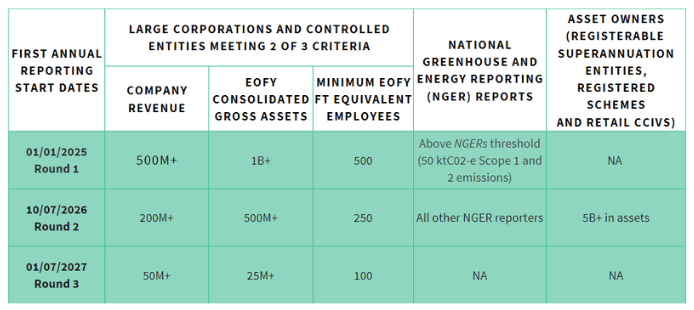
The table outlines the criteria for sustainability reporting starting in 2025. Two of the three columns above must be met to meet the threshold. The largest companies have been reporting on NGERs will automatically report on sustainability.
Turnover summary
Group 1: Entities with consolidated revenue of $500 million or more must report by January 2025.
Group 2: Entities with revenue of $200 million or more must report by July 2026.
Group 3: Entities with revenue of $50 million or more must report by July 2027.
Certain small and medium-sized businesses will be exempt from these requirements. If you have a small business, turnover under 50m and have less than 100 employees, you do not need to report internally, however through the tender process, businesses, no matter what size, will be asked to demonstrate that their business follows sustainable practices and may even have to report monthly to the client. You will be asked to demonstrate you have a sustainability policy, as these requirements are linked to independent sustainability submissions for government projects over 20m.
Key Reporting Requirements
What will larger businesses need to report on? Sustainability reports will now include a climate statement detailing:
Material climate-related risks and opportunities
Scope 1, 2, and 3 greenhouse gas emissions, and
Governance, strategy, and risk management related to climate issues.
How is this different to NGERs reporting? Mainly the climate risks/risk management and scope 3 emissions. To ensure accuracy, and as most annual reporting require, sustainability reports will be subject to external audits, with a gradual increase in assurance requirements over time, just like any ISO standard.
Liability Protections
The reporting structure offers a modified liability framework for entities, providing immunity from civil claims regarding specific disclosures made in sustainability reports for the initial years of implementation. This aims to encourage compliance while promoting transparency.
Preparing for Compliance
As the start date approaches, many businesses are conducting gap analyses to transition from voluntary to mandatory reporting. Legal teams are being tasked with ensuring that companies understand their obligations, streamline reporting processes, and manage potential risks associated with climate disclosures.
If your business doesn’t yet need to complete internal sustainability reporting but your clients do, are you ready to assist in their scope 3 emissions and able to evidence their risk management? Examples include Modern Slavery Act, the right certificates/ accreditations for sustainable products etc?
The Sustainable Procurement course will complete the gap analysis and set up your business to meet your client and future client demands. If you need to start reporting internally, the Sustainability Strategy course will assess your business’ risks and opportunities and will set out action plans, giving your business direction on how to reduce emissions.
For more information on compliance timelines and requirements, it is encouraged to consult the detailed guidelines laid out in the legislation.